Solutions by market

Data Centers

A data hall generates almost no latent load of its own, and nothing downstream of the DOAS is selected to remove the moisture that arrives with ventilation and pressurization air. Viking OA holds supply dewpoint to the ASHRAE TC 9.9 envelope so the cooling plant never sees it.
The challenge

The challenge in this building type

Elevated supply-water temperatures keep CRAH coils and fan walls dry by design. That makes the dedicated outdoor air system the sole point of latent control in the building, and its part-load latent capacity the number that decides whether the hall stays inside the envelope.

Dry coils downstream

CRAHs and fan walls at elevated water temperatures remove sensible heat only. Every grain of moisture that enters with ventilation, pressurization and infiltration air is the DOAS's to remove.

Pressurization through door cycles

Positive pressure is what keeps infiltration from bypassing the dewpoint control. The supply fan has to reset against a hall-to-ambient differential, not run at a fixed speed.

Dewpoint, not relative humidity

TC 9.9 writes the recommended envelope in dewpoint terms. A unit controlled to RH chases a number that moves with temperature; a unit controlled to dewpoint holds the one that matters.

8,760 hours and N+1

The duty never stops and the cooling plant has redundancy. The ventilation and pressurization stage should have it too, without a spare 80-ton unit sitting idle.

Systems

Recommended systems

The KCC equipment that fits this building type, and the roof interface it lands on.
PRIMARY RECOMMENDATION

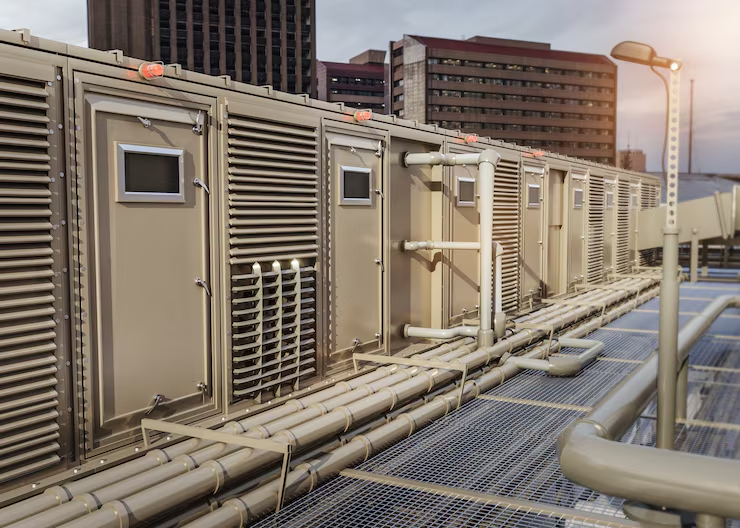
Viking OA

Selected at 95°F DB / 78°F WB at an SHR of 0.70 or below, holding supply dewpoint as low as 43°F with modulating hot-gas reheat. Two OAD cabinets in place of one OAK give N+1 at the ventilation stage on one controls platform.
PAIRED SYSTEM

Viking HA

The mixed-air platform for the spaces around the hall: NOC, offices, electrical and battery rooms, where partial outdoor air and a moderate latent load call for the same cabinet construction and controls.
ROOF INTERFACE

Curbs & adapters

Structural curbs, curb adapters, walkways and hatches engineered with the unit on the same campus. Corner weights, clearances and rigging published in IOM-A001 before the crane is scheduled.
Codes & Compliance

Codes & compliance

ASHRAE TC 9.9

Recommended envelope defined by dewpoint and RH limits. Viking OA is selected and controlled to a dewpoint setpoint across ambient conditions.

ASHRAE 90.4

Energy standard for data centers. Recovered reheat and wheel preconditioning reduce the DOAS contribution to the mechanical load component.

ASHRAE 62.1

Ventilation for occupied support spaces, delivered at a controlled state with optional intake airflow monitoring.

AHRI 920

Certified DX-DOAS performance under ASHRAE SSPC 198, the method of test KCC engineers helped write.

PROJECT PROOF
Named project, named outcome

One-line result with a number in it. Every vertical page carries at least one installed-performance proof point.

FAQ

Frequently asked questions

Why does a data center need a dedicated outdoor air system if CRAHs or fan walls handle the cooling?

Because they run dry. At elevated supply-water temperatures the CRAH and fan-wall coils remove sensible heat only, so the moisture that enters with ventilation, pressurization and infiltration air has nowhere else to go. The DOAS is the only latent-removal device in the building and has to be selected as one.
A dewpoint below the ASHRAE TC 9.9 recommended upper limit for the hall, with margin for the pressurization air mixing in. Viking OA holds a leaving-air dewpoint as low as 43°F with modulating hot-gas reheat, so the air arrives dry and neutral rather than dry and cold.
Yes, by cabinet count. Two OAD cabinets (10–30 tons each) in place of one OAK (30–60 tons) run lead/lag with automatic failover on alarm. Each cabinet is complete at the unit and does not depend on the network to run.
Yes. KCC has built roof curbs and curb adapters for national OEMs for nearly four decades. On a Viking job the curb, the unit and the corner weights are engineered together and published in IOM-A001, so the roof interface is not a coordination item between two vendors.
TALK TO KCC

One call to a rep who answers.

Redundancy, pressurization strategy and the schedule are reviewed by KCC Applications Engineering with your local rep. One call.